News
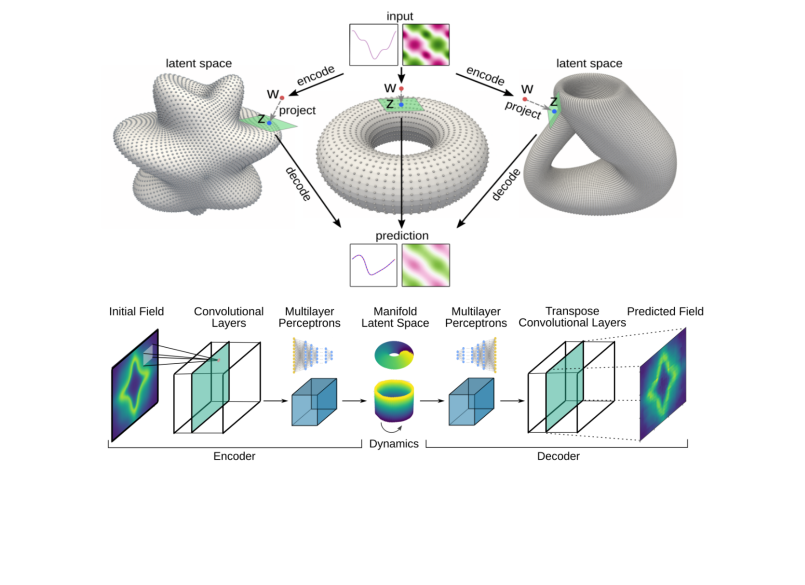
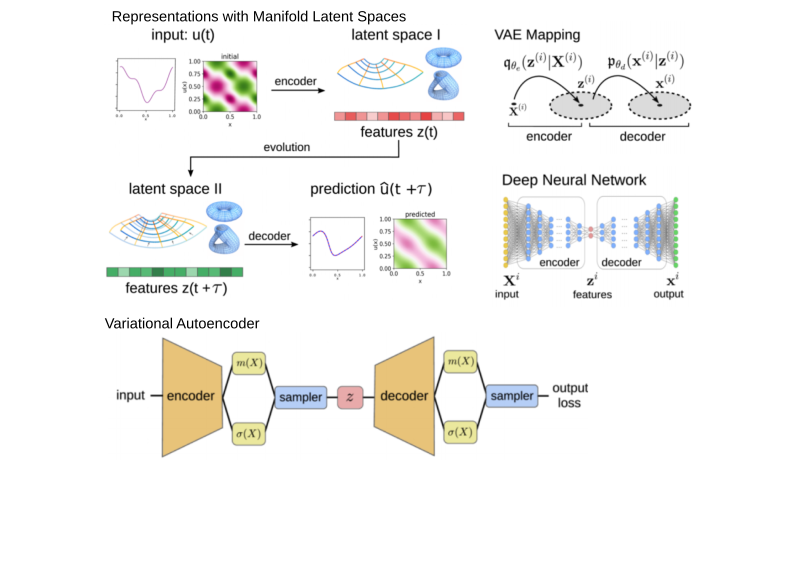
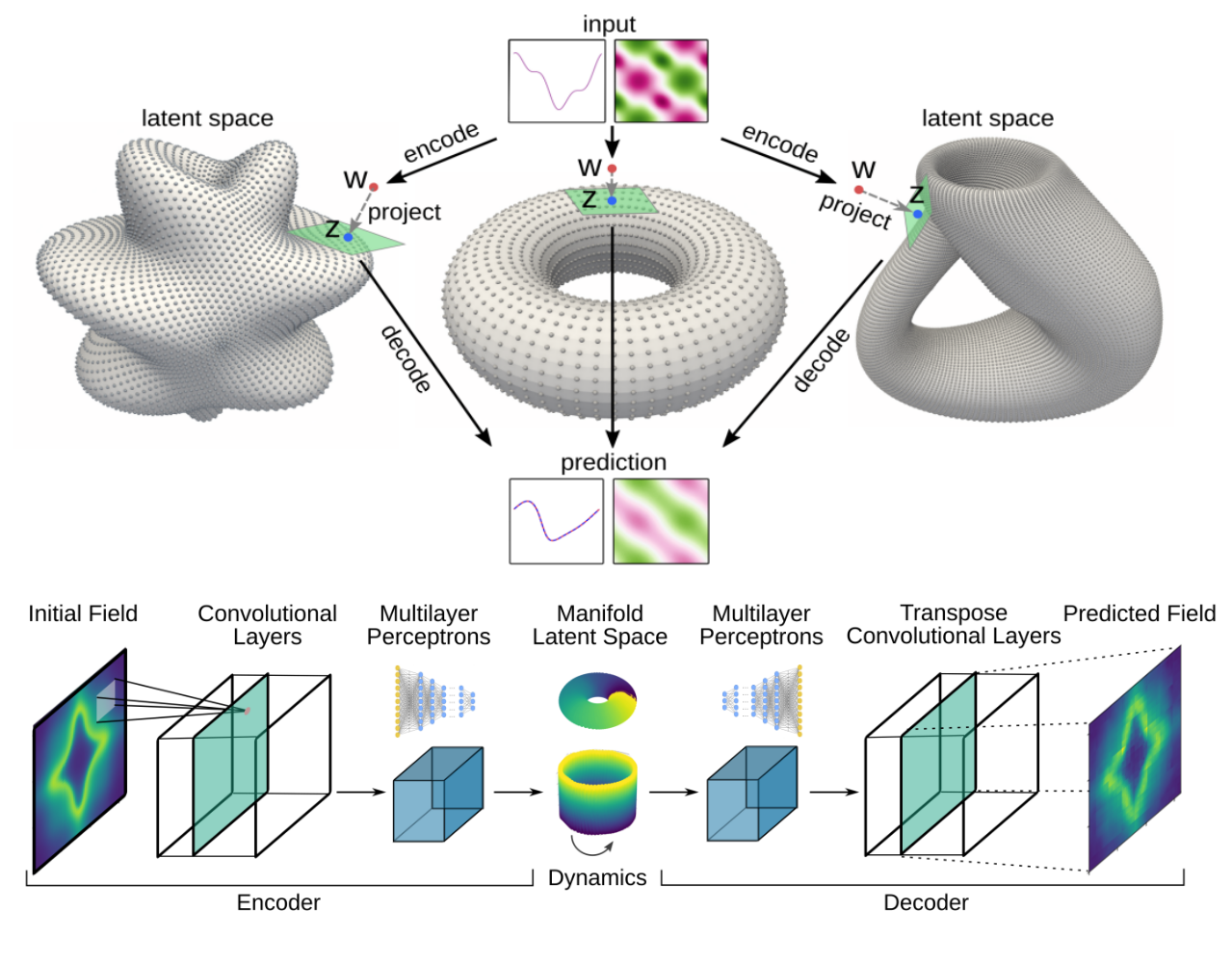
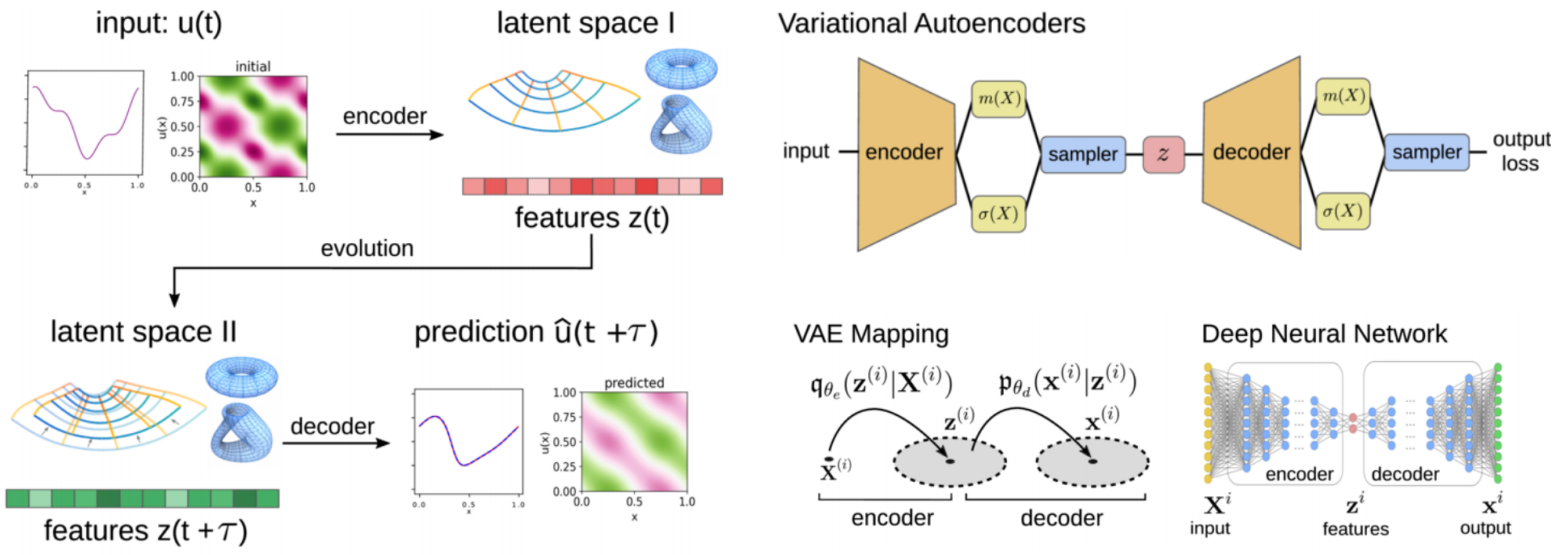
GD-VAEs: Geometric Dynamic Variational Autoencoders
GD-VAEs: Geometric Dynamic Variational Autoencoders for Learning Nonlinear Dynamics and Dimension Reductions, R. Lopez and P. J. Atzberger, (2022), [paper].
Software package for pytorch: [software].
Neural Networks for Learning Nonlinear Dynamics
SDYN-GANs: Adversarial Learning Methods for Multistep Generative Models for General Order Stochastic Dynamics, P. Stinis, C. Daskalakis, and P. J. Atzberger, (2023),
[paper]
Variational Autoencoders for Learning Nonlinear Dynamics of Physical Systems, R. Lopez and P. J. Atzberger, (2020), [paper].
Software package for pytorch: [software].
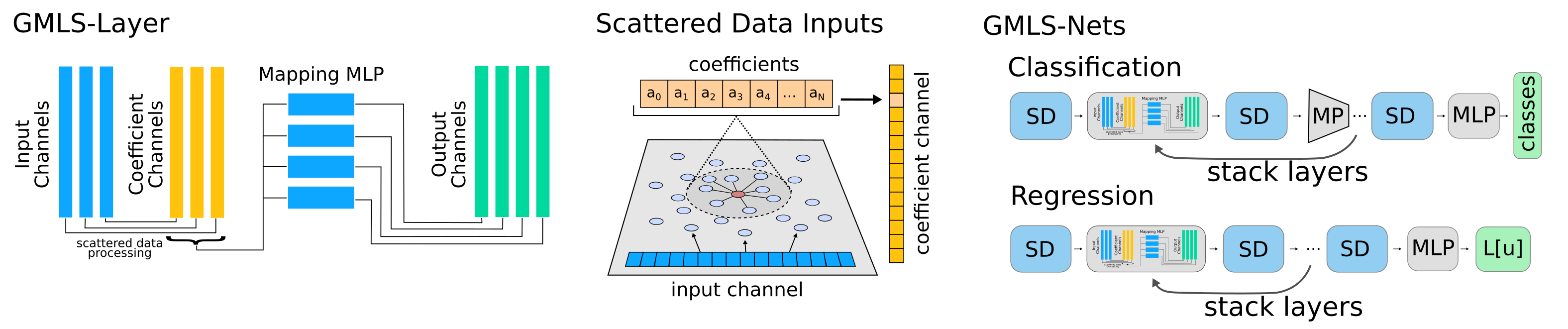
GMLS-Nets for Learning Operators on Scattered Data Sets
GMLS-Nets: A Framework for Learning from Unstructured Data, N. Trask, R. G. Patel, B. J. Gross, and P. J. Atzberger, arXiv:1909.05371, (2019), [paper].
Software package for pytorch: [software].
Careers in Mathematics and related Fields
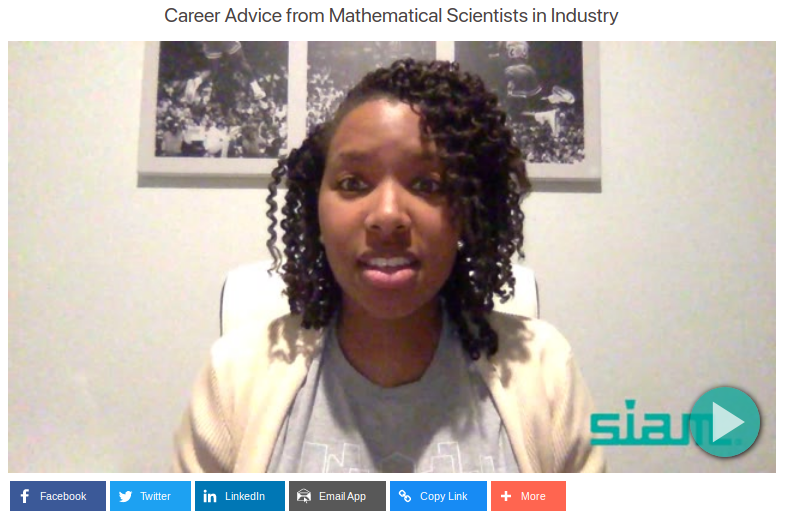
Career Advice from Mathematical Scientists (Video)
Career Information I [PDF]
Career Information II [PDF]
Postdoctoral Position Available in Scientific Computation and Machine Learning.
Funding has become available for a new postdoctoral position concerning research on machine learning methods and related approaches in scientific computation. To apply, please see link here. Some additional information can be found in position paper and recent UC Current Article.
April 2022: Congratulations to Patrick Tran on being award National Science Foundation (NSF) Graduate Student Fellowship!
April 2022: Congratulations to Ryan Lopez on being admitted to graduate program at Massachusetts Institute of Technology (MIT)!
April 2022: Congratulations to Daniel Guo on being admitted to graduate program at Columbia University!
September 2021: Congratulations to Patrick Tran on the research Goldwater Fellowship!
August 2021: Congratulations to Samarth Kadaba on Poster Award at SMB 2021! Congratulations also on acceptance to Stanford University!
July 2021: Congratulations to Christian Bueno on his thesis defense and graduation!
June 2021: Congratulations to Andrew Gracyk on his thesis defense and graduation!
June 2019: Congratulations to David Rower!
Congratulations to David Rower on acceptance to Massachusetts Institute of Technology (MIT), selection for National Science Foundation (NSF) Graduate Student Fellowship, and receiving UCSB Physics Research Excellence Award!
Profiled on the UCSB Facebook page:
[link]
[link]
[image]
June 2019: Congratulations to Ben Gross on his thesis defense and graduation!
September 2018: Awarded by the US Department of Energy a collaborative grant as part of MMICCs initiative for machine learning and scientific computation.
The grant provides support for research at UCSB and collaborative activities with researchers at Sandia National Laboratories (SNL), Pacific Northwestern National Laboratories (PNNL), and Stanford, Brown, and MIT. Additional information: [PDF] [UC Current Article].
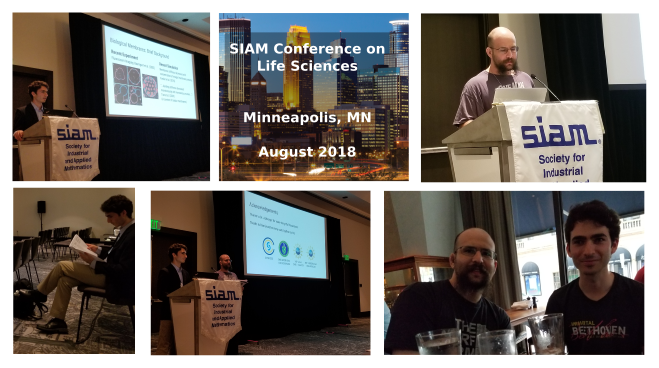
August 2018: David Rower and Ben Gross attending and giving research talks at SIAM Conference in Minneapolis, MN.
SIAM Conference on Life Sciences 2018.
June 2018: Congratulations Ben Gross!
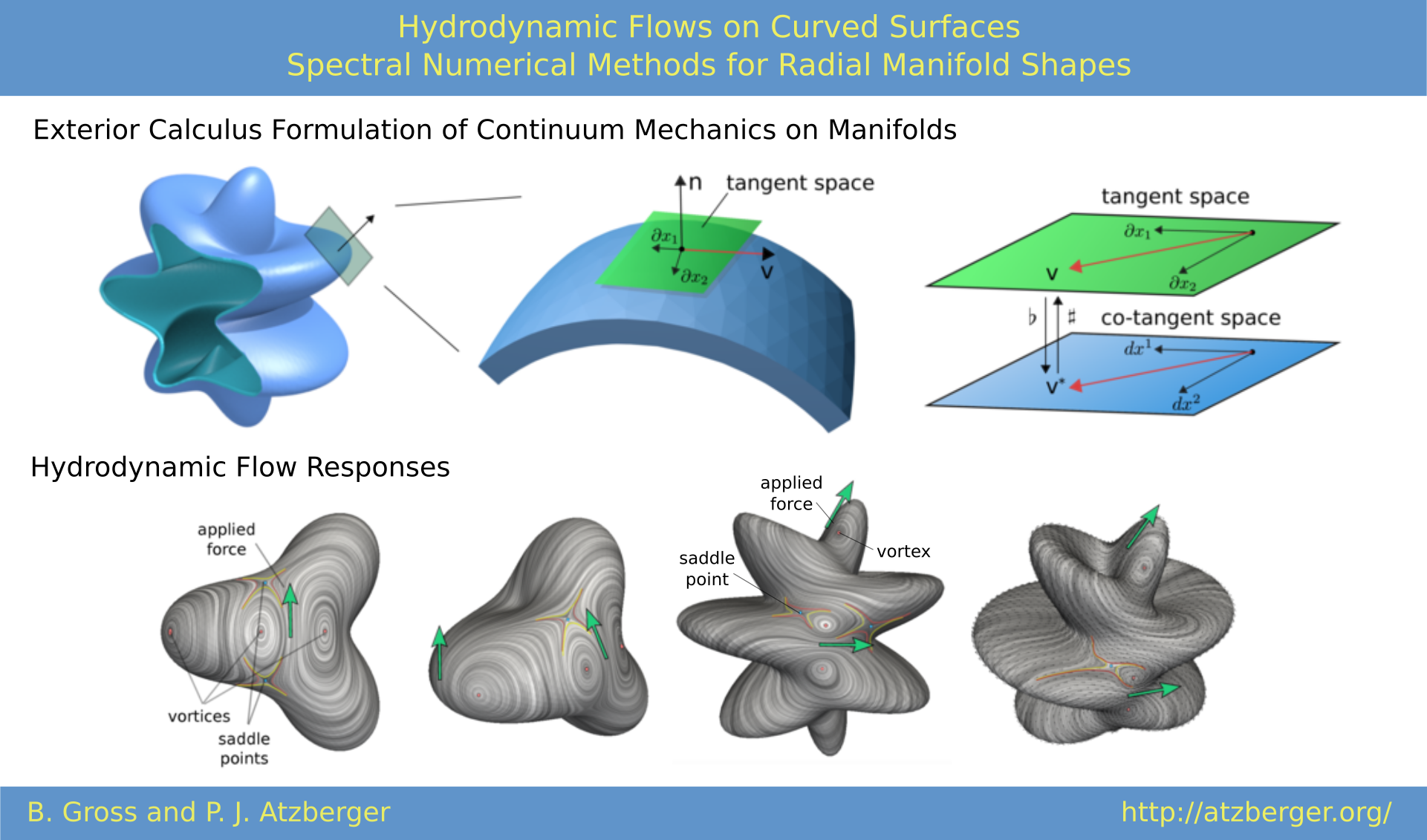
Our recent papers have been accepted to the Journal of Computational Physics and the Journal of Scientific Computing.
[graphical abstract]
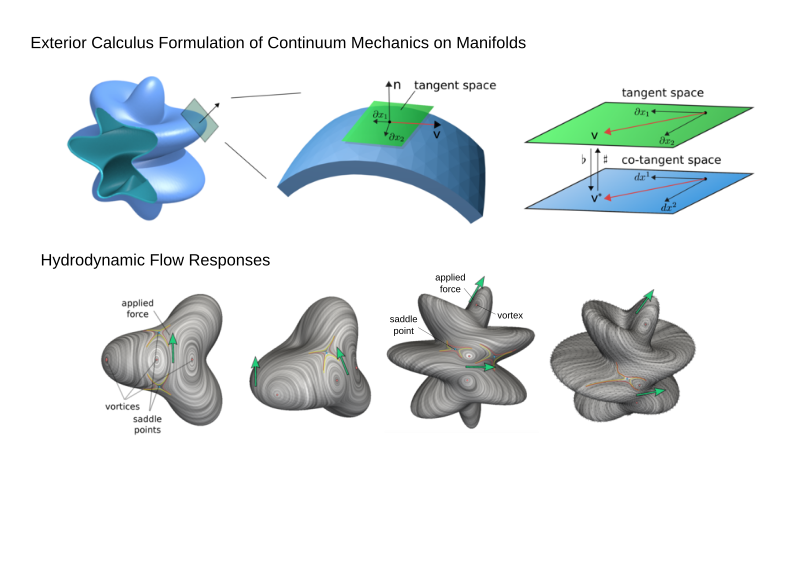
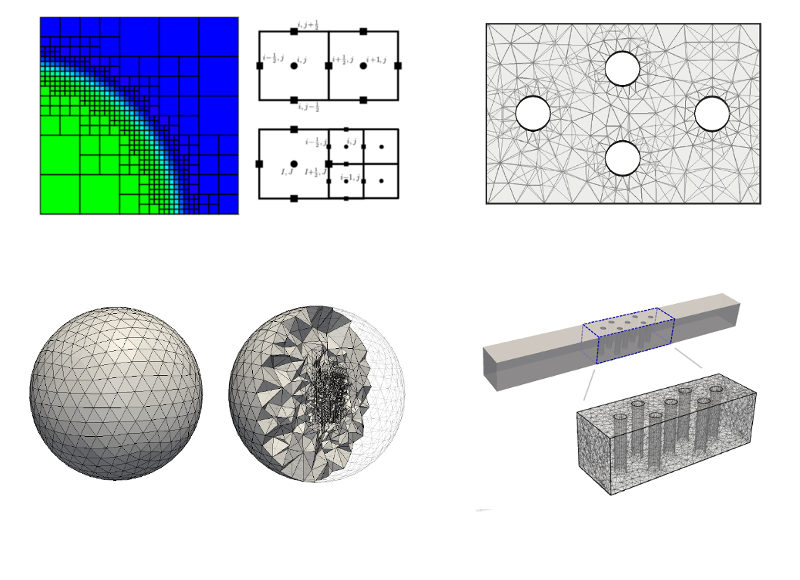
Hydrodynamic Flows on Curved Surfaces: Spectral Numerical Methods for Radial Manifold Shapes , B.J. Gross and P.J. Atzberger, (accepted), J. Comp. Phys., (2018) [preprint] [full paper].
Spectral Numerical Exterior Calculus Methods for Differential Equations on Radial Manifolds , B.J. Gross and P.J. Atzberger, 76, pp 145–165, Journal of Scientific Computing, (2018) [preprint] [full paper].
also see
Meshfree Methods on Manifolds for Hydrodynamic Flows on Curved Surfaces: A Generalized Moving Least-Squares (GMLS) Approach, B. J. Gross, N. Trask, P. Kuberry, and P. J. Atzberger, Journal of Computational Physics, Vol. 409, 15 May (2020), [preprint] [full paper].
[other publications]
May 2018: Teaching Data Science and Machine Learning Courses in Fall 2018
I will be teaching graduate course Special Topics in Machine Learning, Fall 2018.
Also, I will be teaching an undergraduate course Introduction to Data Sciences and Machine Learning, Fall 2018,
In the recent past, I also taught Graduate Course on Machine Learning, Fall 2017 and honors course in Winter 2018
[course notes and related materials].
January 2017: SIAM Life Sciences
As the newly elected Vice-Chair for the SIAM Life Sciences Activity Group, I would like to encourage you to join the LS SIAG. For more information and upcoming conferences / events please see:
https://www.siam.org/activity/life-sciences/
July 2016: UCSB Public Lecture
The Hidden Role of Mathematics and Computation in Scientific Discovery and Engineering.
Public lecture aimed at a general audience as part of the UCSB Seminar Series on Groundbreaking Research / Innovative Technology (GRIT).
[link to video]
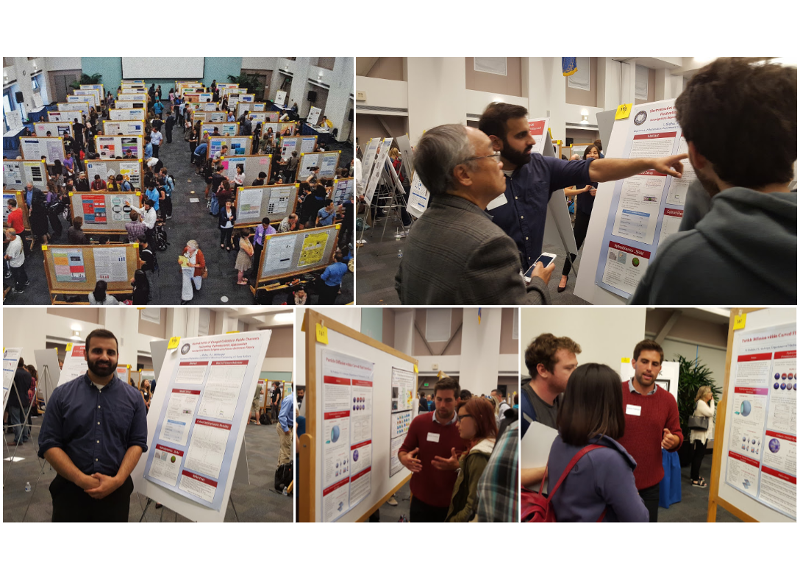
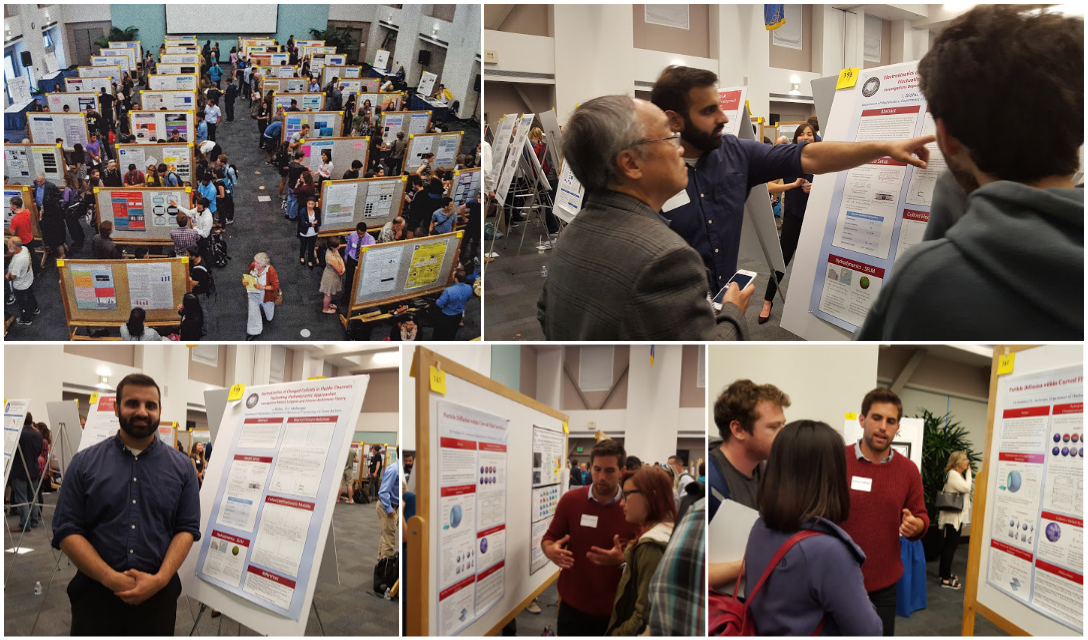
May 2016: Inderbir Sidhu and Misha Padidar present posters on research projects.
UCSB Undergraduate Research Colloquium
June 2016: Summer School on Multiscale Modeling of Materials CM4 (Stanford University, June 20-23, 2016)
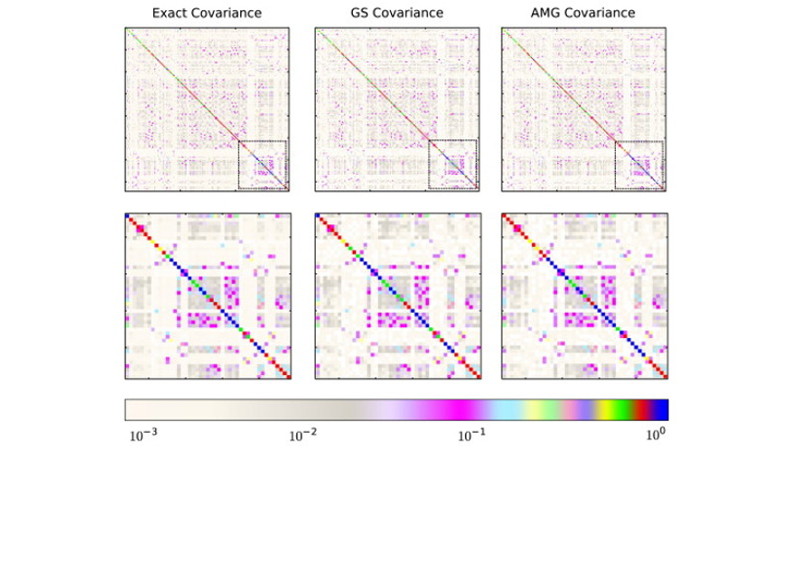
The workshop focuses on mathematical modeling of soft materials and computational methods. We present a tutorial on fluctuating hydrodynamics approaches and our computational package SELM for simulations using the LAMMPS molecular dynamics software.
Summer School Program [website]
Software package SELM for fluctuating hydrodynamics simulations in LAMMPS [software website]
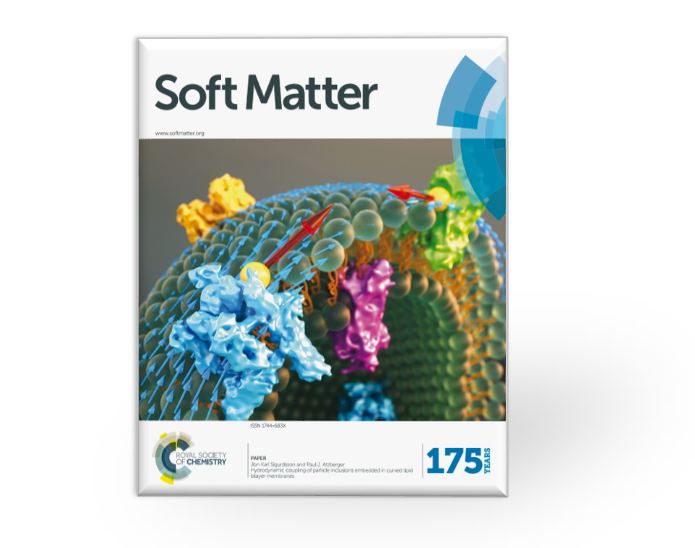
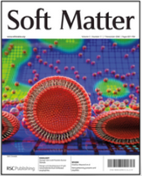
June 2016: Soft Matter Journal highlights on the cover our work on curved fluid interfaces.
This research is reported in the paper
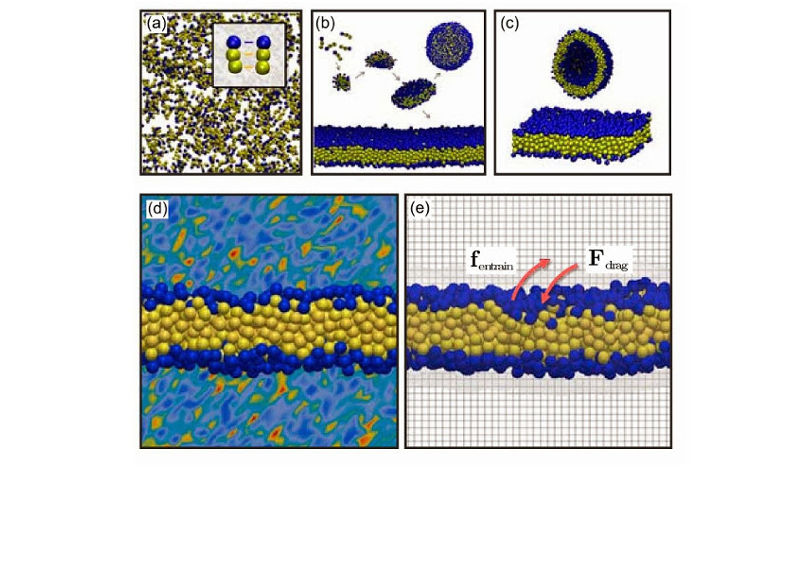
Hydrodynamic Coupling of Particle Inclusions Embedded in Curved Lipid Bilayer Membranes, J.K. Sigurdsson and P.J. Atzberger, 12, 6685-6707, Soft Matter, The Royal Society of Chemistry, (2016) [paper] .
[other publications]
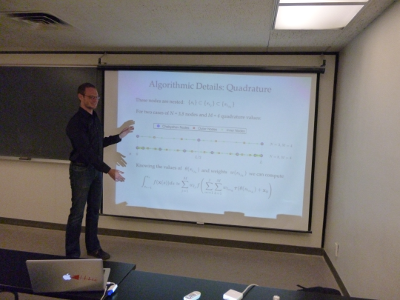
January 2015: UCLA IPAM Talk at Workshop on Partial Order: Mathematics, Simulations and Applications
Fluctuating Hydrodynamics Approaches for Lipid Bilayer Membranes
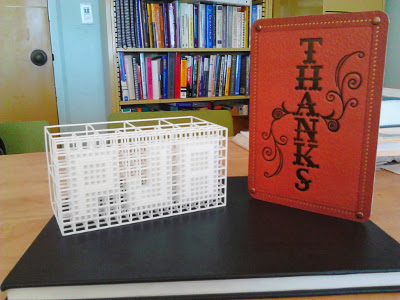
Thanks Pat for the very cool 3D printout of an adaptive mesh! [JPG]
July 2013: Soft Matter Journal has highlighted on the September cover our work on supported lipid bilayers.
This research is reported in the paper
Simulation of edge facilitated adsorption and critical concentration induced rupture of vesicles at a surface, P. Plunkett, B. Camley, K. Weirich, J. Israelachvili, P. Atzberger. [paper]
[other publications]
June 2013: Congratulations to Gil Tabak on winning the Undergraduate Wilder Award!
This research work is reported in the paper
Stochastic Reductions for Inertial Fluid-Structure Interactions Subject to Thermal Fluctuations, G. Tabak and P.J. Atzberger, SIAM J. Appl. Math., 75(4), 1884–1914, (2015). [PDF] [full paper]
[other publications]
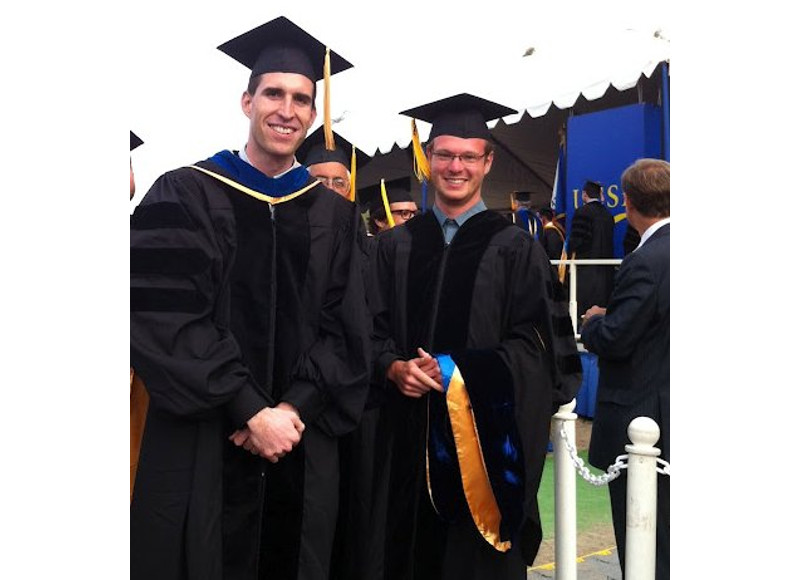
June 2013: Gil Tabak gives CCS Commencement Speech.
December 2012: Software Package Mango-Selm for fluctuating hydrodynamics thermostats has been released!
This is available as part of the Lammps Molecular Dynamics Software (Sandia, DOE). The package allows for dynamic simulations of implicit-solvent coarse-grained models using SELM thermostats. [more information].
December 2012: Awarded from US Department of Energy a collaborative grant to found a MMICCs center on Computational Methods for Soft Materials (CM4).
The grant will provide support for research at UCSB and collaborative activities with researchers at Sandia National Laboratories (SNL), Pacific Northwestern National Laboratories (PNNL), and Stanford, Brown, Penn State, and MIT. Additional information: [CM4 MMICCs Center].
July 2012: David Valdman successfully defends his thesis!
Congratulations to Dr. Valdman!
April-June 2012: KITP Workshop :
Physical Principles of Multiscale Modeling, Analysis and Simulation in Soft Condensed Matter, Coordinators: Paul J. Atzberger, Kurt Kremer, Mark Robbins [link]
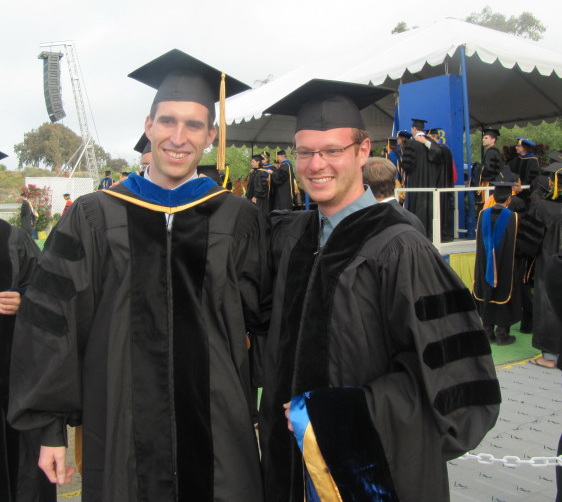
June 2011: Daniel Kerr gives CCS Commencement Speech.
CCS Commencement Speech [Video].









![[link]](https://web.math.ucsb.edu/~atzberg/pmwiki_intranet/uploads/AtzbergerHomePage/2019_June_David_Rower_FB.png)
![[image]](https://web.math.ucsb.edu/~atzberg/pmwiki_intranet/uploads/AtzbergerHomePage/2019_June_David_Rower_FB.png%22)